Marketers are drowning in data. But when it comes to actual, meaningful insights, they’re parched. You know the feeling. Pretending everything is under control as you navigate between countless dashboards, open tabs and versions of the same spreadsheet, pining for numbers that offer validation and direction. We’ve all been there. Leaders don’t need more data or dashboards to get the answers they’re looking for. They need intelligence that proves the “why” behind audience behavior so they can stop apologizing for spending money, and start making faster business decisions with confidence. That starts with a strong, clean data foundation. An effective martech stack isn’t about collecting and configuring mismatched tools that sacrifice data integrity. It’s about eliminating what I call the “complexity tax”—the friction of slow decisions and missed opportunities that plague marketing teams when data doesn’t flow seamlessly. Luckily, we are moving from a world of passive, lagging and disorganized data to an era where social intelligence enables leaders to bypass the complexity tax, prove their ROI and achieve decision velocity. What is a martech stack? A marketing technology stack, or martech stack, is the suite of tools and technologies marketers use to attract, engage and retain customers. From lead generation and email marketing to social media management and SEO, these tools streamline workflows, automate processes and provide critical performance insights. A good martech stack is in a constant state of iteration. As the technology landscape evolves alongside the rise of agentic AI, it’s becoming feasible to transform vast and fragmented metrics into clear voice of the customer narratives. A unified martech stack powered by social intelligence accelerates speed-to-insight, empowers authority building, and gives marketers a complete view of the business and what’s happening right now in the market. The ‘complexity tax’: Why agile marketing technology beats legacy systems Despite the potential for AI-driven martech stacks, many teams aren’t seeing the financial returns they hoped for. Why? Because 36% of executives say legacy infrastructure gets in the way, per Constellation’s 2025 Assessing Agentic Enterprise Readiness Report. Bloated legacy systems prevent data from free flowing between channels, creating silos and manual workarounds that drain team resources. The cost of this bloat is staggering. McKinsey found that 63% of CMOs have missed opportunities because they couldn’t make a decision fast enough, and the Constellation report found that another 42% can’t capture the voice of the customer. Most marketing orgs are still paying premium prices for traditional business intelligence and CRM systems that only track the structured record of the past (i.e., what has already happened inside the business).
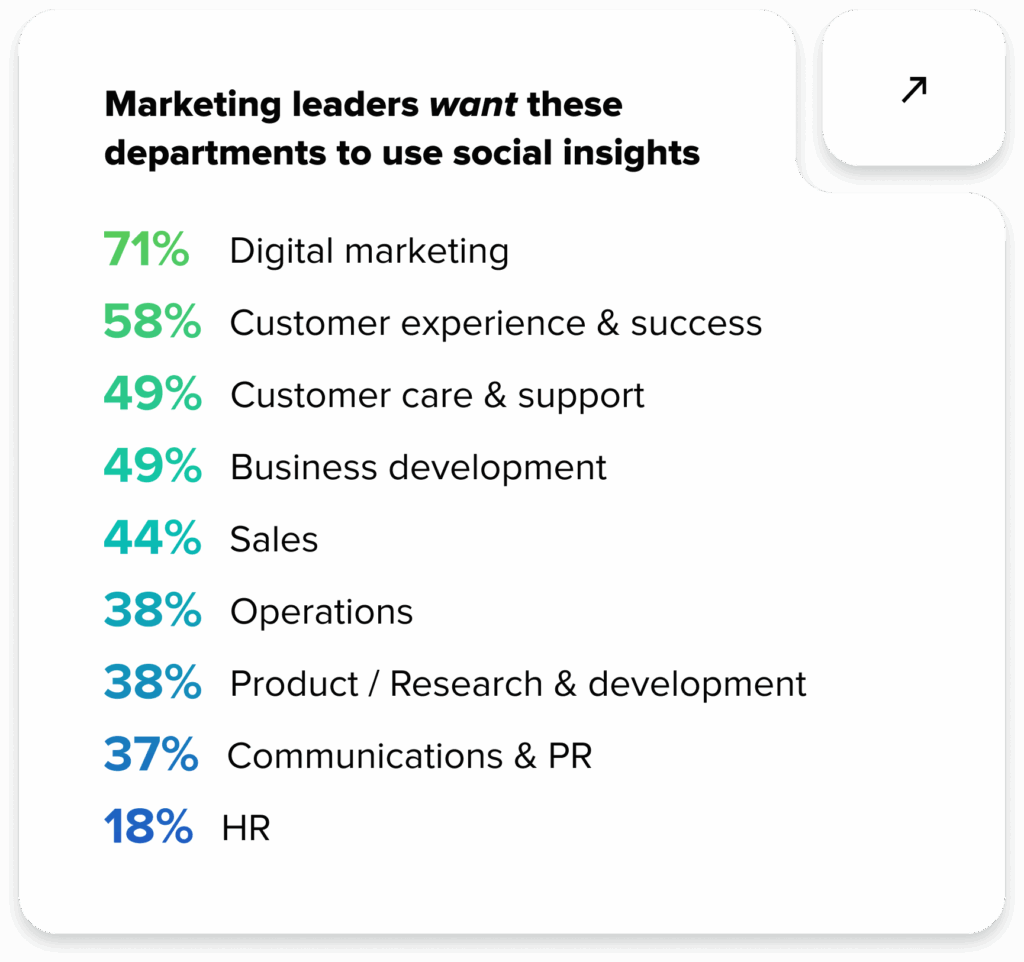
To drive growth, what teams need is social intelligence: the real-time, unstructured context of the market (i.e., what is happening right now). According to Sprout Social’s 2025 Impact of Social Media Report, half of leaders want teams across the business like customer experience and success, customer care and support, and business development to use social insights to inform their decisions. Social intelligence will help these teams move from analyzing the past to moving toward the future with strategic vision. Key components of martech stacks that tame the data firehose There are many tools brands (particularly enterprise brands) use to collect and store data. The good news is that brands have a lot of data—around 10 petabytes, per the Assessing Agentic Enterprise Report. The bad news is that the data firehose is set on high, and legacy systems aren’t built to distill new sources of unstructured data. The same report found that 70% of marketing data is unstructured, including social conversations, videos and images. Traditional martech tools are only built for structured data (like form fills and clicks) and fail to capture the pure, unfiltered audience feedback found on channels like social where real opportunities hide. The makeup of your martech stack that aligns structured and unstructured data depends on your organization’s unique needs and priorities, but certain tools are foundational across industries. Here are some key components that should be included in an effective martech stack:
Social media intelligence tools: Democratizes access to social insights, andsupplies the martech ecosystem with contextual business data and real customer insights that turn noise into actionable business signals, and feeds that real-time context back into the CRM. Allows users to take action in one centralized, streamlined platform. Marketing automation software: Streamlines repetitive tasks and campaign deployments, freeing teams to focus on strategic initiatives. Customer relationship management (CRM) tools: Centralizes customer data and provides insights into how marketing efforts influence sales outcomes. Content management systems (CMS): Powers websites and blogs, serving as the digital front door for customer engagement. Email marketing platforms: Enables email creation, automation and analytics to nurture leads and stay connected with audiences. Generative engine optimization (GEO) tools: Assists with maximizing AI-powered search authority. Search engine optimization (SEO) tools: Aids with keyword research, rank tracking and backlink analysis to enhance organic visibility. Advertising technology: Covers tools for search engine marketing (SEM), display ads and other paid channels to drive traffic. Analytics platforms: Delivers critical insights into website performance and marketing ROI to guide data-driven decisions. Digital asset management (DAM) systems: Organizes and stores digital assets, making it easy to find and reuse content across campaigns.
How to build a martech stack that delivers decision velocity Before I share a practical framework for auditing and rebuilding your martech stack, I need to clarify the critical difference between speed and velocity. Speed means I’m getting in the car and pumping the gas. I’m going to go as fast as I can for as long as I can. But that’s the thing about speed. It doesn’t require direction or impact. Velocity does. Velocity = speed + direction. It means you know exactly where you’re going, and you can pivot instantly based on market signals. When you move with velocity, you move forward with intention, actively seeking out impact and turning insight into action. You have the tools you need to analyze and iterate as you go. In practice, that looks like a martech stack built to process both historical and real-time insights so leaders can make swifter, better decisions. Here are steps you can take to move faster with confidence. Define the problem or need you’re trying to solve People don’t reassemble their tech stacks because they want to. They do it because there is an underlying problem to be solved. Get clear on exactly how your team can benefit from an integrated social media intelligence solution, whether that’s a more accurate view of your sales funnel, share of voice or customer affinity. This will help your IT team better understand your priorities and requirements. Audit your tools and data capabilities Assess your current martech stack by looking more closely at each tool, auditing how well it ingests and analyzes unstructured data. If you can’t get to the “why” behind data points, your data foundation is as fragile as a house of cards and isn’t solid enough for you to build a strategy around. Integrations and data integrity are the fuel that make decision velocity possible. If your suite treats social insights as a siloed add-on or a detached dashboard, you’re missing 70% of your customer’s voice. Social data should be like connective tissue flowing into your CRM and business intelligence tools to create a complete intelligence ecosystem. Define business outcomes focused on impact For a long time, marketers have intuitively known data is missing that would fully demonstrate the impact of their work. We lacked the full picture, unable to see how our campaigns really influenced share of voice and sentiment. AI-driven social intelligence makes it possible to merge different data sources and ask new questions. Such as, who did I reach and how did they react? Where did we succeed? Where did we fall short? Modern martech stack should offer the insights you need to accelerate the time from output to financial impact, turning decisions into action with a laser-focused outcome in mind. Align on cross-functional needs and priorities Prioritize a stack where social signals trigger actions in other departments. When shared effectively, social data should bridge the gap between marketing, sales, service and commerce. For example, consider e.l.f. Cosmetics’ recent product innovation that was informed by customerbehavior on TikTok. The brand saw customers sharing hacks to clear out lipgloss bottles so they could customize their own. Instead of the social team just commenting “love this,” the insight was escalated to product and commerce teams, and the brand launched a new promotion. For every $15 spent on e.l.f. products, customers received a free empty lipgloss container, called a (S)e.l.f. Made Halo Gloss Bottle. The product quickly sold out. That is decision velocity in action.
Build for the future No matter where you’re at on your AI implementation journey, you need to make sure your stack is agentic AI-ready. AI is an insatiable beast that requires a constant diet of human data to remain useful, and social intelligence provides the perfect meal plan. It’s also crucial to leverage social intelligence so you are present where your customers are talking and asking questions about your brand, industry and more, so your brand can become the authoritative answer for LLMs. As we move from SEO to an era dominated by GEO, authority will become a businesses’ greatest discoverability currency. Move with velocity, not complexity “A lion does not need to roar to prove she’s a lion.” That’s a statement I want every marketer to believe, holding their head high knowing with confidence that they have the intelligence infrastructure to create predictable, exponential growth. No more apologizing for spending money, even though we know our business, industry and customer as well as anyone. It’s time to transform our data and dashboards from a reactive scorecard to a predictive financial advantage. Consult Sprout’s Social Media Buyer’s Guide to ensure you have the infrastructure to access the true voice of the customer. The post Building a martech stack: Eliminating the complexity tax for decision velocity appeared first on Sprout Social.