For a small business, Instagram is no longer just a digital portfolio or a place to park your brand’s aesthetic. It is a fully functional revenue engine, a customer care hub and the modern equivalent of a storefront window. But if we are being honest, it can also be a massive time sink. When you are operating with a lean team, or maybe as a team of one, the pressure to constantly feed the algorithm can quickly lead to burnout. You might find yourself chasing fleeting audio trends, guessing at the best time to post and wondering if the hours spent stitching together Reels are actually impacting your bottom line. Why does this happen? Because without a foundational Instagram marketing strategy, social media management shifts from being a proactive growth lever to a reactive daily chore. And when you are reacting, it becomes nearly impossible to measure the actual return on investment (ROI) of your efforts. To win on Instagram today, small businesses need to stop acting like content machines and start acting like strategic marketers. This guide is designed to help you do exactly that. We are moving past “post every day and use 30 hashtags” advice to provide an efficiency-first blueprint for sustainable growth. Whether you are looking to build a dedicated community, streamline your daily workflow or prove the ROI of your social presence, this comprehensive guide will show you how to build an Instagram marketing strategy that works for your business—not the other way around. How to build small business Instagram marketing strategies for growth If you are reading this, you likely already have an active Instagram profile, an engaged community of early supporters and a solid understanding of how the platform works. You are not starting from scratch, you are looking to scale. The tactics that get a small business off the ground are vastly different from the strategies required to drive predictable revenue. Building a true growth strategy means transitioning from reactive daily posting to proactive audience acquisition. It requires you to treat your Instagram presence not as a creative outlet, but as a measurable business channel. Setting goals and proving ROI The most common trap lean teams fall into on Instagram is chasing vanity metrics. It feels undeniably great to get 1,000 likes on a Reel but if those likes don’t translate into newsletter signups, website traffic or direct sales, what is the actual return on your investment? To build a strategy that actually impacts your bottom line, we need to dig deeper. Let’s use the “5 Whys” framework to get to the root of your social objectives. If your initial instinct is to set a goal like, “I want to grow my Instagram following,” ask yourself why until you hit a tangible business outcome:
Why? Because I want more people to see my content. Why? Because more visibility means more brand awareness. Why? Because when people recognize my brand, they begin to trust it. Why? Because trust removes friction and leads to higher conversion rates. Why? Because increased conversions drive revenue and sustainable business growth.
Suddenly, your goal isn’t just about a follower count, it is about building trust to drive revenue. This fundamental shift in mindset changes everything from the captions you write to the calls to action you use. To prove this new strategy is working, you have to measure the right data points. This is where leaning on reliable social media ROI tracking becomes essential. Before worrying about advanced software, start by identifying the specific metrics that map directly back to your bottom-line goals:
Business Goal The Vanity Metric (Avoid) The Growth Metric (Track)
Brand Awareness Follower count Reach and share rate
Lead Generation Post likes Link-in-bio clicks
Community Trust Generic comments Save rate and DM inquiries
Revenue Growth Viral video views Profile conversion rate
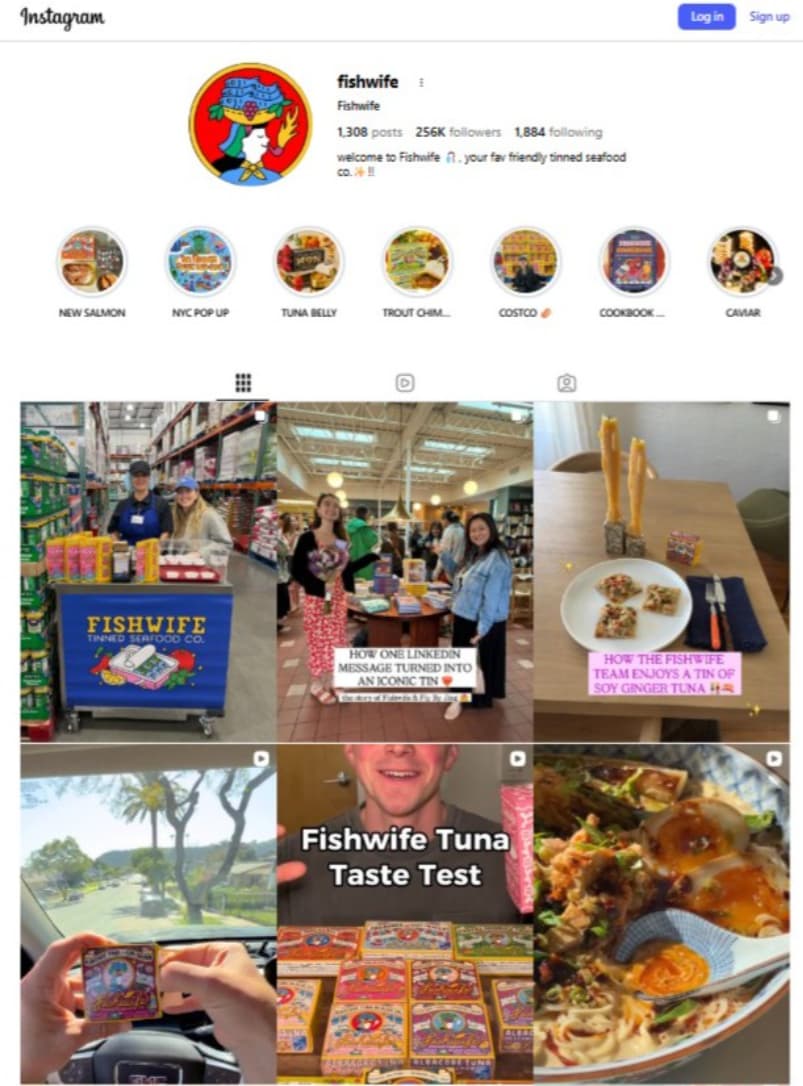
By clearly defining these metrics and setting objectives aligned with revenue from day one, you transform your profile from a creative playground into a measurable growth channel. How to optimize your Instagram profile for small business marketing Think of your Instagram profile as your digital storefront. In 2026, social networks are search engines in their own right. A potential customer is just as likely to search for a new coffee shop or a sustainable clothing brand directly within the Instagram app as they are onGoogle. Optimizing your profile is the foundation of platform discoverability. When someone lands on your page, they should instantly understand who you are, what you offer and why they should care. US premium seafood brand Fishwife thrives on Instagram because their bold visual identity, humor-driven tone and culture-first positioning are immediately apparent the second you tap their profile.
They don’t make you guess what they sell or what their vibe is, it is instantly communicated through their profile setup and grid aesthetic. Instagram bio ideas for small business Your bio is your 150-character elevator pitch. It has to do the heavy lifting to turn a casual profile visitor into an engaged follower or a paying customer. Instead of treating this space as an afterthought or filling it with vague quotes, you need to be strategic. If you want to maximize your Instagram SEO and drive real action, focus on these elements when crafting or updating your bio:
Optimize your name field: Instead of just your brand name, add your niche or location. Irish jewelry brand Chupi uses their name field to highlight “Fine Jewellery,” capturing high-intent search traffic instantly.
State your mission clearly: US allergen-free snack brand Partake Foods uses their bio to instantly communicate their founder-led mission and safety standards, building immediate trust. Include a friction-free call to action (CTA): Australian fashion label White Fox Boutique never leaves a link hanging. Their bio updates constantly to highlight their newest collection or highlight their presence on other social media networks.
Highlight founder visibility: UK fashion brand Odd Muse leans heavily into founder-led storytelling. Mentioning the founder in the bio humanizes the brand and gives visitors a face to connect with before they even scroll. Establish visual personality instantly: Fishwife use emojis and punchy copywriting in their bio that perfectly matches their bold, humorous grid aesthetic, setting expectations immediately.
How to create Instagram content for small business marketing that converts For small businesses, creating content that converts means striking a balance between community building, education and soft selling. If every post is a hard sales pitch, your audience will quickly tune out. Conversely, if every post is an unrelated meme, they won’t know what you actually sell. Instagram post ideas for small business Fortunately, the most effective post ideas for lean marketing teams do not require a Hollywood production budget. Instead, they rely on authenticity, smart curation and leveraging your existing community. If you are looking for inspiration for your Instagram posts these tried and tested post ideas will not let you down:
Behind-the-scenes process: US productivity brand Ugmonk builds authority by showing raw, minimalist glimpses into product development and packaging. Educational carousels: UK-based Tropic Skincare consistently posts ingredient breakdowns and educational content, positioning their grid as a helpful resource rather than just a catalog.
Community-first UGC: US beauty giant Glossier scaled its early business by prioritizing user-generated content, essentially turning happy customers into an extension of their marketing team. Scarcity and aesthetic drops: French fashion brand Sézane masters the art of the product drop. They use lifestyle-heavy grid posts to tease limited-edition items, driving massive anticipation.
Direct response copywriting: Australian skincare brand Frank Body built an empire on playful, highly recognizable brand voice captions that always end with a clear action step for the reader.
Small business captions for Instagram A stunning visual might stop the scroll but a compelling caption is what drives the conversion. When writing for your grid, you must treat the first sentence of your caption as a headline. You have a fraction of a second to hook the reader before they swipe past. Frank Body mastered this early on. Their success stems from a highly distinctive, playful brand voice paired with direct-response copywriting. They don’t just list product ingredients; they speak directly to the customer’s desires, use formatting to make the text readable and always end with a clear action step. To save yourself hours of agonizing over copy build a library of Instagram captions tailored to your specific content pillars. Create reusable Instagramtemplates for:
Product launches. Frequently asked questions. Customer testimonials. Behind-the-scenes stories.
Having a proven formula prevents you from staring at a blank screen and ensures your brand voice remains consistent. Instagram hashtags for small business Hashtag strategy has evolved significantly over the last few years. The days of pasting a block of 30 generic tags like #SmallBiz or #InstaGood into your comments are over. Today, Instagram’s algorithm uses hashtags to semantically categorize your content and serve it to high-intent users on the Explore page and in search results. Instead of going broad, you need to go niche. Use a strategic mix of hyper-local tags, specific industry terms and targeted community identifiers. For example, if you run a sustainable fashion boutique in London, using tags like #LondonEthicalFashion or #SustainableStyleUK will put you directly in front of buyers actively looking for your exact aesthetic. How to create an Instagram Reels strategy for small businesses While inconsistent posting or audience fatigue can certainly cause your Instagram growth to plateau, a missing video strategy is usually the primary culprit behind a lack of new discovery for small businesses. In 2026, Reels are the primary discovery engine on the platform. While standard grid posts are excellent for nurturing your existing followers, Reels are how you get pushed into the feeds of users who do not follow you yet. However, many small business owners avoid video because they assume it requires complex editing software, professional lighting or jumping on cringe-worthy dance trends. A sustainable reels strategy strips all of that away. It focuses on low-lift, high-impact video formats that can be batched in a single afternoon and grow your reach for weeks ahead. Instagram Reel ideas for small business The most successful small business Reels focus on utility, relatability or behind-the-scenes authenticity rather than high production value. If you look at your current reels strategy and realize they are taking too much time for too little reward, try pivoting to these proven, highly efficient formats: Product-in-use demos: Stop telling people how great your product is and simply show them. Travel accessory brand Beis excels at this. Their Reels feature relatable travel scenarios, like trying to cram too many shoes into a carry-on, that naturally highlight their bag’s functionality. You can easily replicate this by filming a 10-second clip of your product solving a common customer frustration.
Educational myth-busting: Use your industry expertise to provide immediate value. If you run a skincare clinic, film a short video debunking a common skincare myth. Educational content establishes your authority, naturally encourages users to save the video (a massive positive signal to the algorithm) and positions your business as the ultimate solution. Founder stories and daily operations: People connect with people, not logos. Showing the human side of your business builds incredible loyalty. Record a time-lapse of you packing orders, share the story of why you started the business or film a quick “day in the life” vlog. These raw, unpolished videos consistently outperform highly edited corporate commercials because they feel native to the platform. To make video creation manageable for a lean team, the secret is batching. Dedicate two hours a month to filming raw clips, then use your scheduling tools to organize, caption and auto-publish them over the coming weeks. How to choose the best Instagram posting schedule for small business marketing? If you are looking for a baseline, checking the global best times to post on Instagram is a fantastic starting point. These data-backed guidelines provide a solid foundation for growing accounts looking to maximize their initial reach. However, as your strategy matures, the truth becomes much more nuanced: the ultimate posting schedule is the one you can consistently maintain. The Instagram algorithm rewards predictability. If you train your audience to expect a new educational Reel every Tuesday morning and a community spotlight every Friday, the platform takes note of that habitual engagement. Tropic Skincare maintain a high frequency of educational ingredient breakdowns, ambassador UGC and community shoutouts. This volume of content is only sustainable and algorithm-friendly, because it follows a strict, deliberate schedule rather than relying onspontaneous, ad-hoc posting. How to measure Instagram marketing ROI for small business? When you first launch a small business on Instagram, native platform insights are usually enough. Watching your follower count tick up or seeing a post get more likes than usual provides great early validation. But as you transition from establishing a presence to actively scaling your revenue, those vanity metrics lose their benifit. You cannot pay your suppliers with likes. To scale sustainably, you must prove your return on investment. This requires a shift from looking at surface-level engagement to tracking bottom-line impact. Key Instagram metrics to track A mature growth strategy requires you to measure metrics that indicate true audience intent and business value. As you evaluate your performance, prioritize these data points:
Saves and shares over likes: A like is a passive action. A “save” indicates your content was so valuable the user intends to return to it. A “share” means they are actively endorsing your brand to their own network. These are the highest signals of algorithmic and commercial value. Profile conversion rate: It is not enough to track how many people visit your profile; you need to know what they do once they get there. Monitor the ratio of profile visits to link-in-bio clicks or direct message inquiries. If traffic is high but clicks are low, your bio CTA needs optimizing. Traffic and revenue attribution: The ultimate measure of Instagram ROI is what happens off the app. Use UTM parameters on your links to track exactly how much website traffic, how many email signups and how much direct revenue is being generated from your Instagram efforts.
Relying on manual spreadsheets to track these advanced metrics is inefficient. Growing brands rely on unified social media analytics tools to automatically aggregate this data, allowing them to instantly see which campaigns are driving revenue and which are falling flat. How to manage Instagram marketing efficiently for small business? The biggest hurdle to scaling a small business on Instagram isn’t a lack of creativity, it is a lack of time. When you are managing inventory, leading a team and handling customer support, social media often becomes an exhausting afterthought. The businesses that succeed on Instagram don’t necessarily work harder; they work smarter. They recognize that manual, ad-hoc management is the enemy of growth. To manage your marketing efficiently, you must build systems that allow you to punch above your weight class and look like a fully staffed social team, even if you are a team of one. Automating your Instagram workflow This brings us to the most critical operational shift for a growing small business: stepping away from manual publishing. When you are part of a lean marketing team, your time is your most valuable asset. Instead, efficiency-first marketers rely on automation. By leveraging Sprout Essentials, a dedicated social media scheduling tool designed for growing brands, you can block off a single afternoon to write captions, tag products and queue up your content for the entire month and generate presentation-ready ROI reports in seconds. By removing the manual friction of daily social media management, you buy back the time you need to focus on what actually matters: growing your business. The post Instagram marketing for small business: A strategic guide to sustainable growth appeared first on Sprout Social.
